You've been told a hundred different numbers. One gram per pound. Two grams per kilo. "Just eat more chicken." Your gym buddy swears by protein shakes every two hours. Some influencer says you need 200 grams minimum or you're wasting your workouts.
Here's the thing: the research on protein and muscle growth is actually pretty clear. Scientists have studied this extensively, and we have solid answers. The problem is that most advice ignores a critical variable — what you're actually trying to do with your body right now.
Someone cutting 10 pounds of fat has very different protein needs than someone in a lean bulk. Let's break down exactly what the science says for each scenario.
Quick reference: Cutting: 2.2–2.6 g/kg (~1.0–1.2 g/lb) | Maintaining: 1.8–2.2 g/kg (~0.8–1.0 g/lb) | Bulking: 1.6–2.0 g/kg (~0.7–0.9 g/lb)
What Protein Actually Does for Muscle
Every time you train, you create microscopic damage in your muscle fibers. Your body repairs that damage through a process called muscle protein synthesis (MPS) — and it needs amino acids from dietary protein to do it.
If you eat enough protein, MPS outpaces muscle protein breakdown, and you build tissue. If you don't, you'll still get benefits from training, but you'll leave muscle gain and retention on the table. Your body can't build efficiently with materials it doesn't have.
This is why protein matters more than any other macronutrient for body composition. Carbs fuel your workouts. Fats support your hormones. But protein is the only macro that directly builds and preserves the muscle you're working for.
How Much Protein Per Day?
A landmark 2018 meta-analysis by Morton and colleagues looked at 49 studies and over 1,800 participants. Their finding: 1.6 grams of protein per kilogram of bodyweight per day (~0.73 g/lb) is the point where muscle-building benefits start to plateau.
That doesn't mean zero benefit above 1.6 — just smaller gains, and individual needs vary. Schoenfeld and Aragon's review that same year recommended a range of 1.6 to 2.2g per kg per day (~0.73–1.0 g/lb) to maximize muscle growth, giving a buffer for individual variation.
That's the baseline. But here's where it gets interesting — your goal changes where you should land within that range, and sometimes pushes you beyond it.
Protein for Fat Loss (Cutting)
Target: 2.2–2.6g per kg of bodyweight (~1.0–1.2 g/lb)
This is counterintuitive. You're eating less food overall, but you need more protein than someone who's bulking. Why?
When you're in a calorie deficit, your body is looking for energy anywhere it can find it. That includes your muscle tissue. Higher protein intake acts as a muscle-preservation shield — it keeps MPS elevated even when total calories are low.
A 2014 review by Helms and colleagues found that lean, resistance-trained individuals in a deficit should aim for 2.3 to 3.1g per kg of fat-free mass to minimize muscle loss. For most people, that translates to roughly 2.2–2.6g per kg of total bodyweight. If you're significantly overweight, base this on your goal weight or lean body mass rather than current scale weight.
What this looks like in practice:
For an 80kg (176 lb) person cutting:
Daily target: 176–208g of protein
Per meal (4 meals): 44–52g per meal
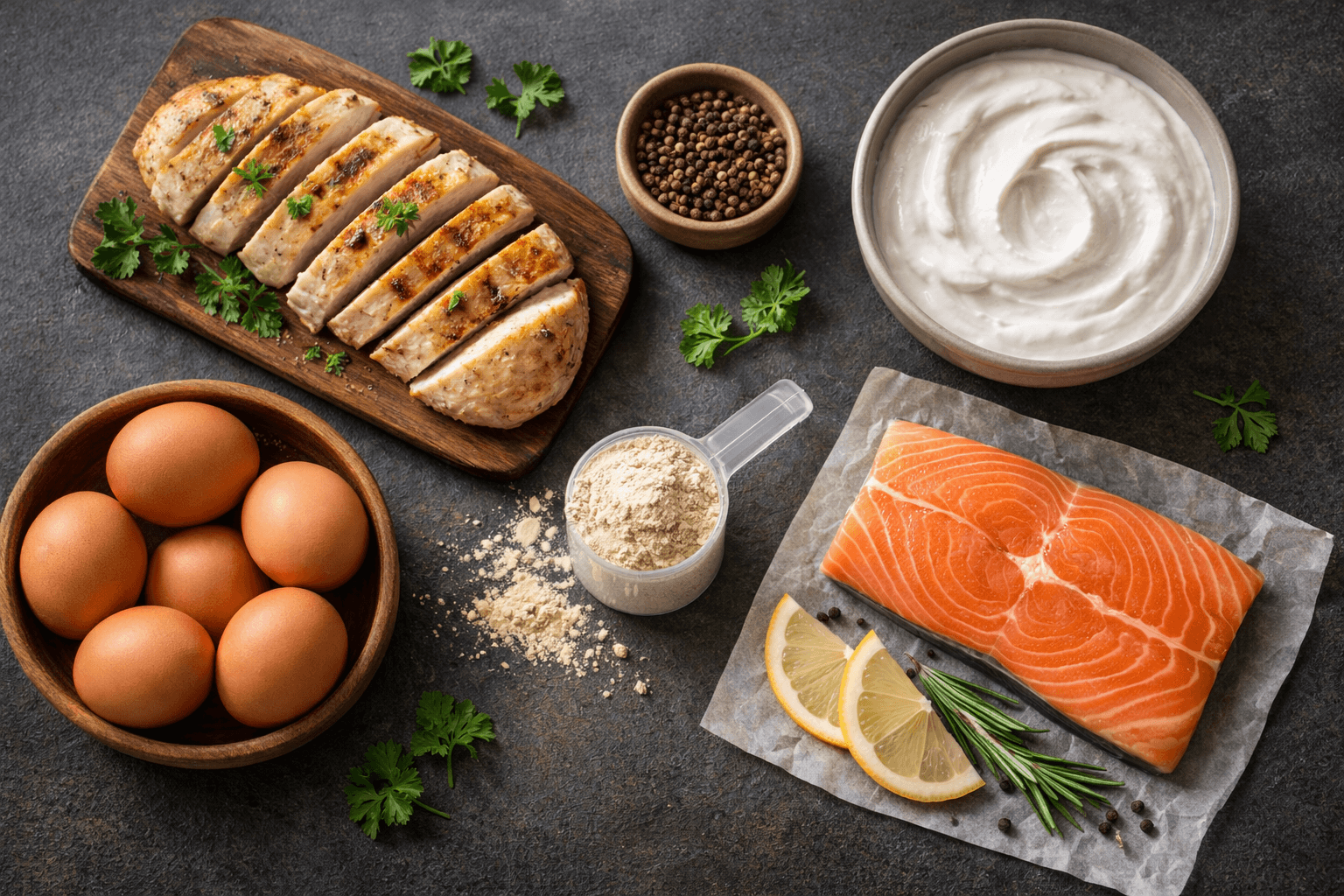
Priority foods: Chicken breast, white fish, egg whites, Greek yogurt, whey protein
The practical challenge during a cut is that protein is the most satiating macronutrient — which is actually a benefit. It keeps you fuller on fewer calories. Lean protein sources become your best friend here because they deliver the amino acids without eating into your limited calorie budget.
The key insight: A cut is the worst time to slack on protein. If you're going to be precise about one thing during a deficit, make it this.
Protein for Body Recomposition (Maintaining)
Target: 1.8–2.2g per kg of bodyweight (~0.8–1.0 g/lb)
Body recomposition — losing fat and building muscle simultaneously — is the goal most people actually want but rarely name. You're eating around maintenance calories, training hard, and letting your body composition shift over time.
This is the sweet spot of the research range. You're not in a deficit where muscle is at risk, and you're not in a surplus where extra protein is less critical. You just need enough to support consistent MPS from your training.
What this looks like in practice:
For an 80kg (176 lb) person maintaining:
Daily target: 144–176g of protein
Per meal (3–4 meals): 36–59g per meal
Priority foods: Mix of lean and fattier protein sources — chicken thighs, salmon, whole eggs, beef, cottage cheese
At maintenance, you have more flexibility. You don't need to obsess over lean-only sources because your calorie budget is more forgiving. Focus on hitting the daily number consistently rather than perfectly.
Distribution matters slightly more here. Research suggests spreading protein across 3–4 meals with at least 25–40g per sitting optimizes MPS throughout the day. Not because of some "anabolic window" myth, but because there's a ceiling to how much protein your body can use for muscle building in a single meal.
Protein for Muscle Gain (Bulking)
Target: 1.6–2.0g per kg of bodyweight (~0.7–0.9 g/lb)
When you're in a calorie surplus, you can actually get away with less protein than the other scenarios.
Why? The surplus itself is protein-sparing. When your body has plenty of energy from carbs and fats, it's less likely to tap into amino acids for fuel. Your muscles get first priority on the protein you eat.
This is good news, because it means in a bulk you can allocate more of your calories to carbs — which fuel harder training sessions and support recovery.
What this looks like in practice:
For an 80kg (176 lb) person bulking:
Daily target: 128–160g of protein
Per meal (4 meals): 32–40g per meal
Priority foods: Whatever you enjoy — whole eggs, chicken, beef, dairy, legumes, protein-enriched foods
The biggest mistake during a bulk isn't under-eating protein. It's over-eating protein at the expense of carbs. If you're forcing down 250g of protein, you're probably leaving performance on the table by not eating enough carbohydrates to fuel your training.
The key insight: In a surplus, hit 1.6g/kg as your floor and spend your remaining calories on carbs and training fuel.
Common Protein Mistakes
Obsessing over timing. The "anabolic window" — the idea that you must consume protein within 30 minutes of training — has been largely debunked. Total daily intake matters far more than when you eat it. Just don't cram all your protein into a single meal.
All-or-nothing thinking. Missing your target by 15 grams doesn't erase your workout. Protein targets are averages, not cliffs. Hitting 90% of your target consistently beats hitting 100% three days a week.
Supplement over-reliance. Protein powder is a convenience tool, not a magic ingredient. It's just food. Whole protein sources come with micronutrients, fiber, and satiety that a shake can't match. Use supplements to fill gaps, not as your primary source.
Not tracking at all. Most people dramatically overestimate their protein intake. Studies consistently show that when people guess, they're off by 30–40%. You don't need to track forever — but tracking for even two weeks recalibrates your intuition about what adequate protein actually looks like on a plate.
How to Actually Hit Your Target
Forget meal prep empires and complicated macro calculators. Here's a simple framework:
1. Anchor each meal around a protein source. Before you think about sides, pick your protein: chicken, fish, eggs, Greek yogurt, tofu, beef, whatever. Build the meal around it.
2. Know your go-to portions. A palm-sized portion of meat is roughly 25–30g of protein. Two eggs are 12g. A cup of Greek yogurt is 15–20g. You don't need a food scale for the rest of your life — just long enough to calibrate your eye.
3. Have a fallback. For days when meals don't come together, have one reliable backup: a protein shake, a carton of egg whites, a pack of beef jerky. Something fast that closes the gap.
4. Track for two weeks. That's it. Not forever. Just long enough to see where you actually land versus where you think you land. The gap will surprise you, and the awareness sticks long after you stop logging.
Frequently Asked Questions
Is high protein bad for your kidneys?
In healthy individuals, no. Multiple studies have found no adverse effects of high-protein diets on kidney function in people without pre-existing kidney disease. If you have kidney disease or a related condition, talk to your clinician — that's a different conversation entirely.
What if I'm vegetarian or vegan?
The same targets apply. Plant-based protein sources — tofu, tempeh, legumes, seitan, protein powder (pea, rice, soy) — can absolutely get you there. The main difference: plant proteins tend to be less bioavailable and lower in certain amino acids, so aiming for the higher end of your target range and eating a variety of sources helps ensure you're covered.
The Bottom Line
Protein recommendations aren't one-size-fits-all. Your target depends on what you're doing:
Cutting: Go higher (2.2–2.6g/kg / ~1.0–1.2 g/lb) to protect your muscle in a deficit
Maintaining: Hit the middle (1.8–2.2g/kg / ~0.8–1.0 g/lb) and focus on consistency
Bulking: The lower end works (1.6–2.0g/kg / ~0.7–0.9 g/lb) — spend the extra calories on carbs
Pick your scenario. Know your number. Hit it most days. That's the entire strategy.
Knowing your target is step one. Actually tracking it is step two. Ellim makes step two easy — log meals manually, scan a barcode, or snap a photo and let AI detect your macros. Whatever gets you to your number with the least friction.