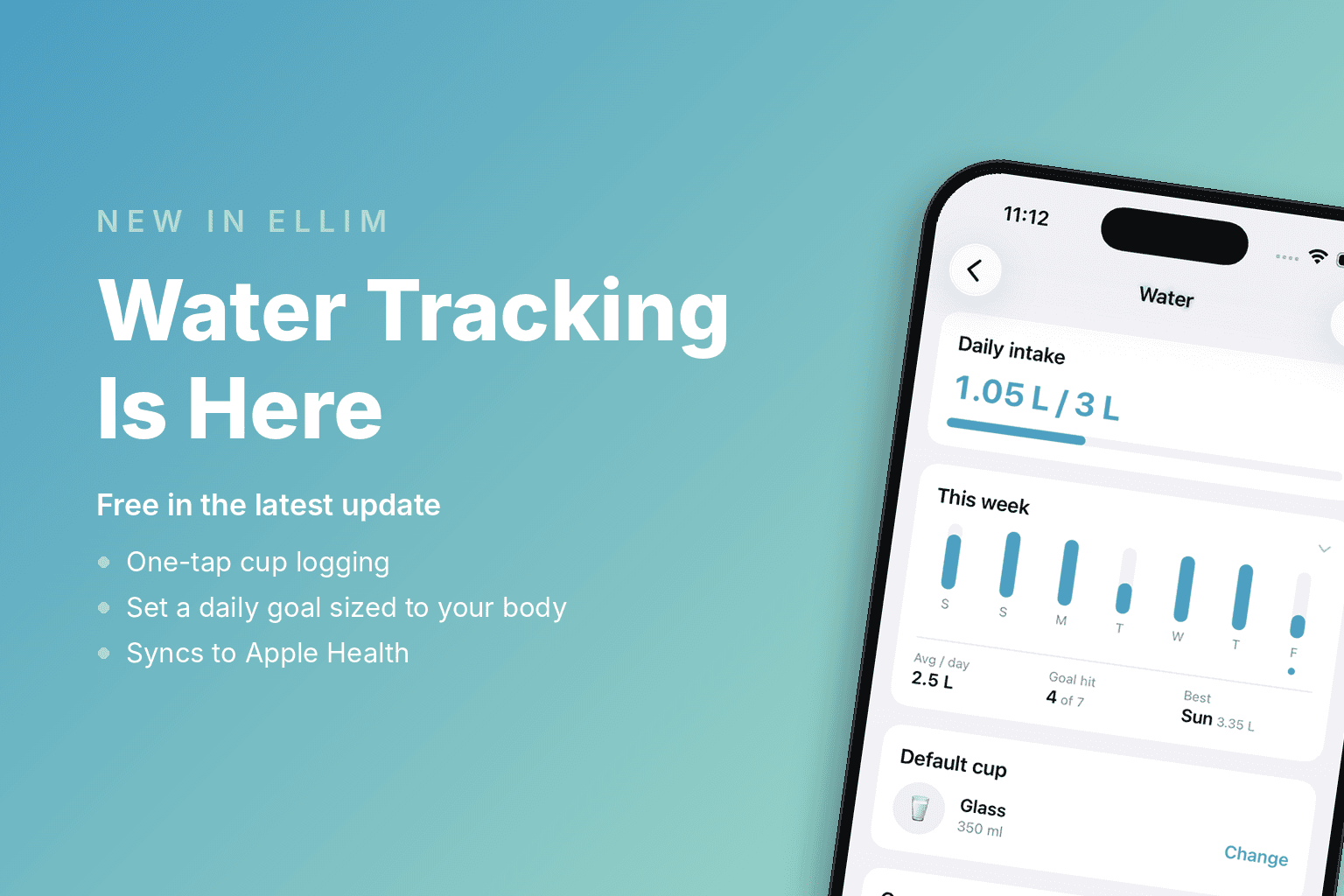
Workouts, meals and water have lived on your Today tab. As of the latest App Store update, the fourth pillar joins them: sleep tracking is now built into Ellim for iPhone, read straight from Apple Health, and it's free.
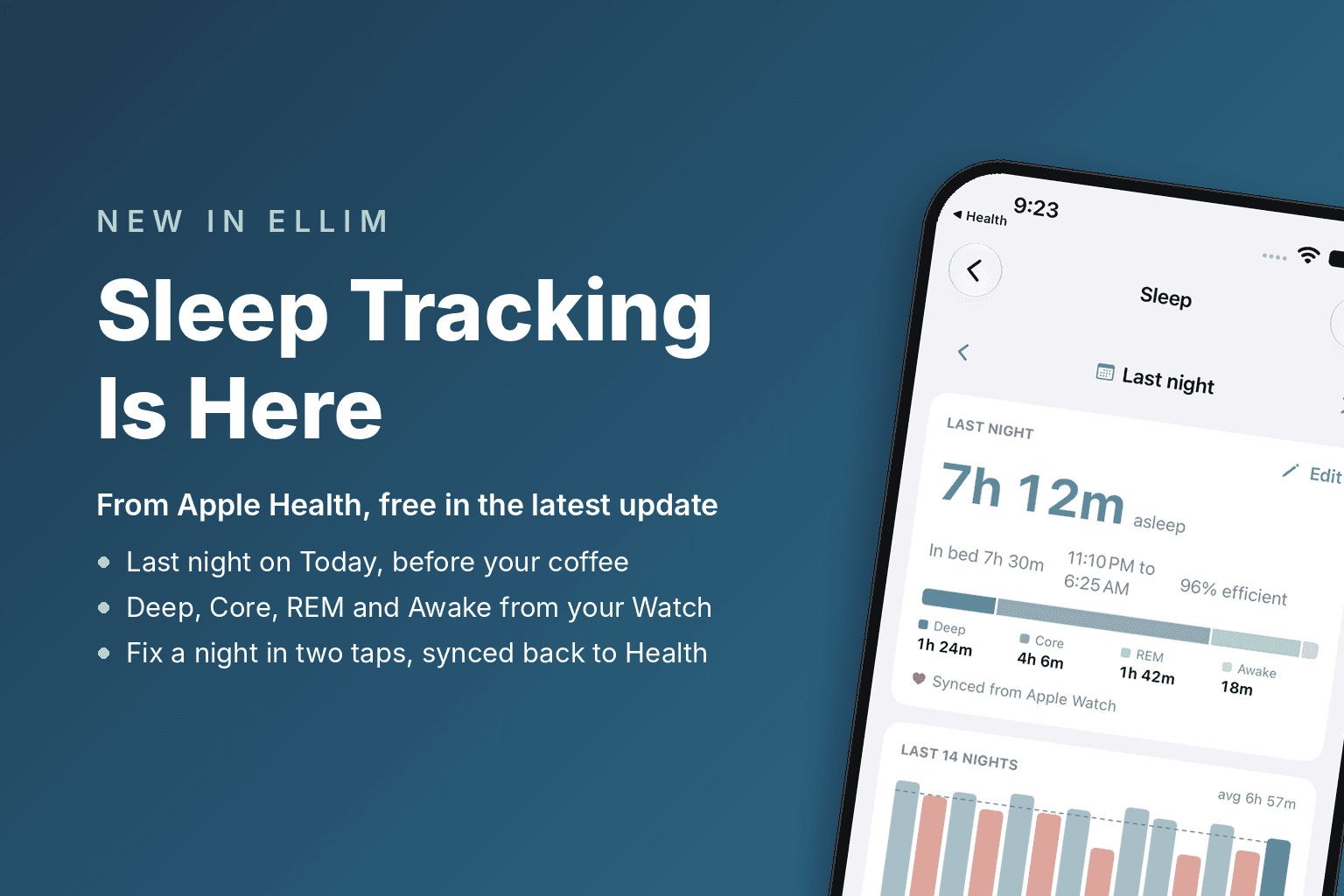
Wear your Apple Watch to bed. Open Ellim in the morning. Last night is already there.
Why we built it
Sleep is the recovery variable every coach agrees matters and almost nobody looks at next to their training. Your Watch records it faithfully every night, and then it sits in the Health app, doing nothing for your programme.
Ellim is built around one honest picture of your day. Training, food and water were already in it. Sleep is the piece that explains why the same workout feels easy one week and impossible the next.
What a short night does to a heavy session
This is the part worth reading even if you never connect Apple Health. The studies are small, but they point the same way, and the numbers are bigger than most lifters assume.
Your compound lifts get weaker, and evening sessions take the hit
A 2018 systematic review of 17 studies found that repeated nights of restricted sleep reduce maximal force in multi-joint lifts (think squat, bench, deadlift) while single-joint movements barely change. One bad night is not the problem. A bad week is.
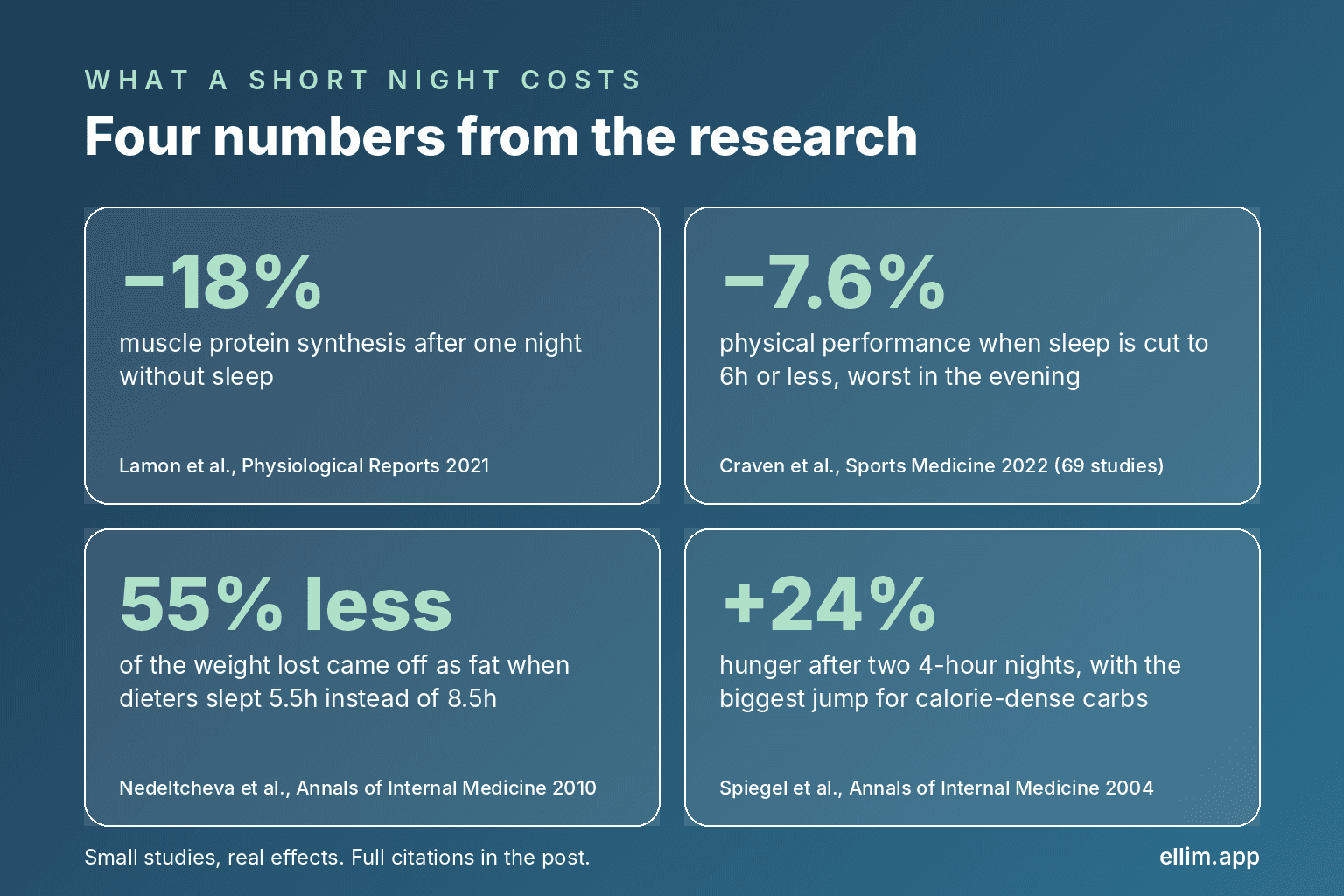
The largest pooled analysis to date, 69 studies in Sports Medicine (2022), put the average performance cost of sleeping 6 hours or less at about 7.6%, and found the drop concentrated in evening sessions. Morning performance was largely unaffected. If you're short on sleep, the practical move is simple: train early, or make it a technique day.
Your body builds less muscle from the same work
In a 2021 crossover study, one night of total sleep deprivation cut muscle protein synthesis the next day by 18%, while cortisol rose 21% and testosterone fell 24%. The same training stimulus, less muscle built from it.
It compounds. Five nights of four hours in bed lowered myofibrillar protein synthesis by roughly 19% in young men. Interestingly, three high-intensity interval sessions during those short nights held it at normal levels. Training helps. It does not replace sleep.
And the hormonal cost is not subtle: eight nights of about five hours in bed lowered daytime testosterone in healthy young men by 10 to 15%. The authors note that normal ageing manages 1 to 2% a year.
What a short night does to a cut
You lose the wrong weight
The study every nutrition coach quotes is Nedeltcheva et al., 2010: the same calorie-restricted diet for two weeks, sleeping 5.5 hours versus 8.5. Total weight loss was nearly identical, around 3 kg. But the short sleepers lost 55% less of it as fat and 60% more of it as lean mass. Ten people, two weeks, so treat the exact percentages lightly. Treat the direction seriously.
A larger 2018 trial followed 36 adults through eight weeks of dieting with about an hour less sleep on five weeknights. Same total weight lost, a smaller share of it as fat, and catching up on weekends did not undo it.
You get hungrier, for exactly the wrong food
Two nights of four hours in bed were enough to drop leptin 18% and raise ghrelin 28% in healthy young men. Hunger went up 24%, and the biggest jump in appetite, 33 to 45%, was for calorie-dense, high-carb food. A deficit is hard enough with your hormones on your side.
The honest caveats
These are small studies, mostly in young men, over days or weeks. There is no meta-analysis showing sleep loss blunts long-term muscle gain, and one 2024 study found men sleeping about 6h15 gained similar strength and arm size over five weeks as men sleeping about 7h45. Sleep is a lever, not a switch. This is general information, not medical advice.
For a target: the American Academy of Sleep Medicine puts the adult minimum at 7 hours, the National Sleep Foundation says 7 to 9, and the 2021 athlete consensus says the right number is individual. Which is exactly why it helps to see your own nights next to your own sessions.
How it works in Ellim
Connect Apple Health once
Ellim reads sleep, and only sleep: when you went down, when you got up, and the Deep, Core, REM and Awake breakdown if your Watch tracks stages. Not your steps, not your heart rate, not your location. If more than one device writes sleep to Health (an Apple Watch and a phone, or an Oura or Whoop), Ellim keeps the source with the most recorded sleep for each night, so nothing double-counts.
Last night on Today, before your coffee
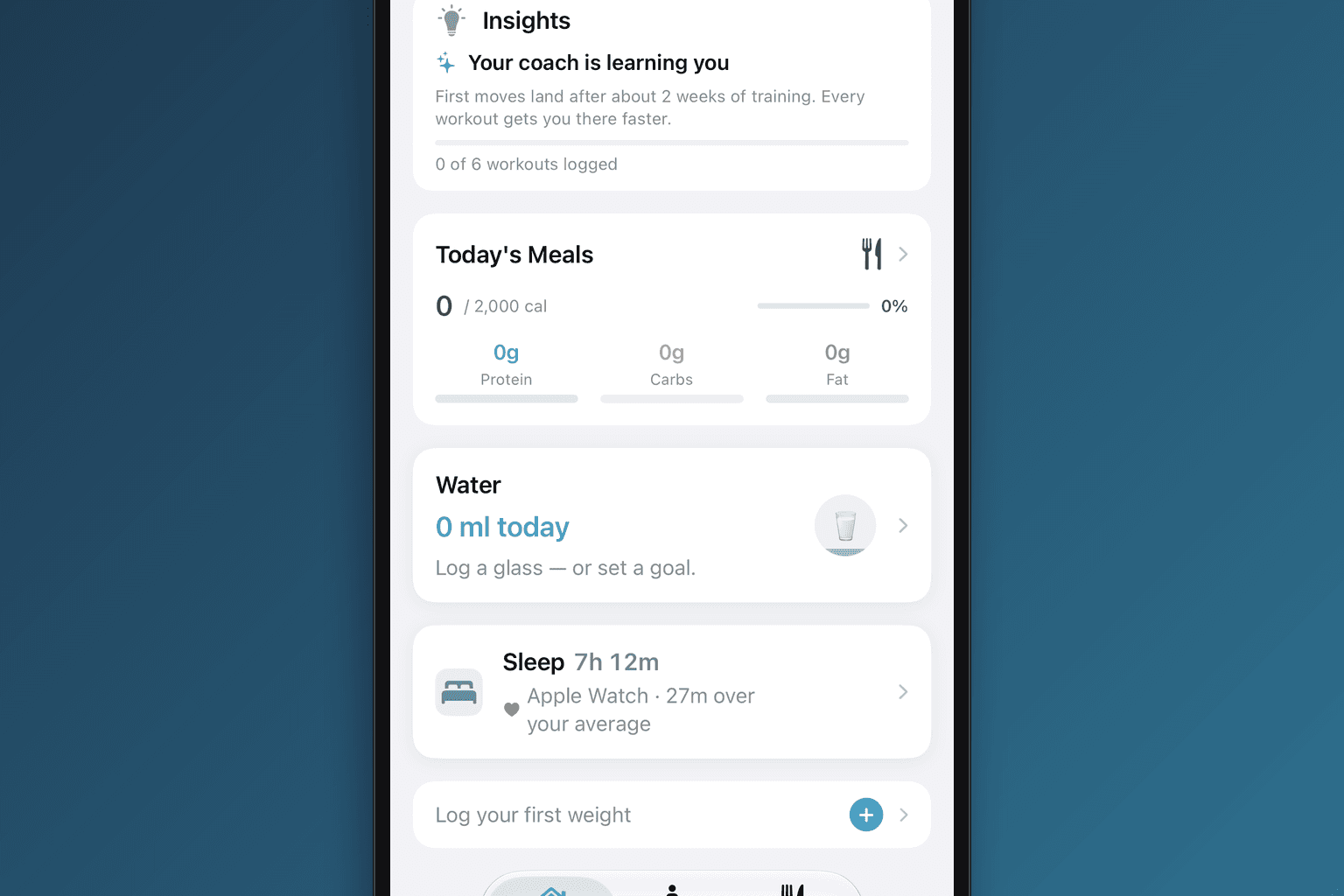
The sleep row on Today shows how long you slept and where that sits against your recent average. Tap it for the full night: the bedtime-to-wake window, time in bed, sleep efficiency, and the stage bar.
Every night, one swipe back
Swipe back through your nights one at a time, or jump to any date from the calendar. Both are free.
Health got a night wrong? Two taps.
Slept without your Watch, or Health split a night in two? Add or fix the bedtime and wake time, and optionally note how you felt: rough, ok, or rested. Only the nights you add or fix are written back to Apple Health, so both apps tell the same story. What your Watch recorded stays exactly as it is, and Health never overwrites your edits.
Short nights in red (Premium)
Premium adds the 14-night trend, the night list, and the dots on the calendar. Nights under 7 hours, the AASM adult minimum, are marked in red, so a short week is obvious before it becomes a flat week.
What about the coach?
Not yet. Sleep is being collected now so your coach has something real to read. Adjusting a session because of the nights you actually had is what we're building toward, and we'll say so here when it ships, not before.
Free vs Premium at a glance
Free | Premium | |
|---|---|---|
Last night on Today | ✓ | ✓ |
Night detail with stages and efficiency | ✓ | ✓ |
Swipe back through any night | ✓ | ✓ |
Calendar date picker | ✓ | ✓ |
Add or fix a night, written back to Health | ✓ | ✓ |
14-night trend | — | ✓ |
Night list and calendar dots | — | ✓ |
Short nights flagged in red | — | ✓ |
How to start
Update Ellim to the latest version from the App Store.
Open the Today tab and tap Connect on the Sleep row. Apple asks what to share; sleep is all Ellim requests.
Wear your Watch to bed. Last night will be waiting in the morning.
Workouts, meals, water, and now sleep. Four parts of your day that decide how the fifth one goes, in one place. Make yourself the #1 priority.
Your Watch already knows how you slept. Let Ellim in on it: Download Ellim free on the App Store →
Sources
Knowles OE et al. Inadequate sleep and muscle strength: implications for resistance training. J Sci Med Sport 2018. PubMed
Craven J et al. Effects of acute sleep loss on physical performance: a systematic and meta-analytical review. Sports Med 2022. PubMed
Lamon S et al. The effect of acute sleep deprivation on skeletal muscle protein synthesis and the hormonal environment. Physiol Rep 2021. PubMed
Saner NJ et al. The effect of sleep restriction, with or without high-intensity interval exercise, on myofibrillar protein synthesis in healthy young men. J Physiol 2020. PubMed
Leproult R, Van Cauter E. Effect of 1 week of sleep restriction on testosterone levels in young healthy men. JAMA 2011. JAMA
Nedeltcheva AV et al. Insufficient sleep undermines dietary efforts to reduce adiposity. Ann Intern Med 2010. PubMed
Wang X et al. Influence of sleep restriction on weight loss outcomes associated with caloric restriction. Sleep 2018. PubMed
Spiegel K et al. Sleep curtailment in healthy young men is associated with decreased leptin levels, elevated ghrelin levels, and increased hunger and appetite. Ann Intern Med 2004. PubMed
Borba DA et al. Could a habitual sleep restriction of one-two hours be detrimental to the benefits of resistance training? Sleep Sci 2024. PMC
Watson NF et al. Recommended amount of sleep for a healthy adult: AASM and SRS joint consensus statement. Sleep 2015. PubMed
Hirshkowitz M et al. National Sleep Foundation's sleep time duration recommendations. Sleep Health 2015. PubMed
Walsh NP et al. Sleep and the athlete: narrative review and 2021 expert consensus recommendations. Br J Sports Med 2021. PubMed